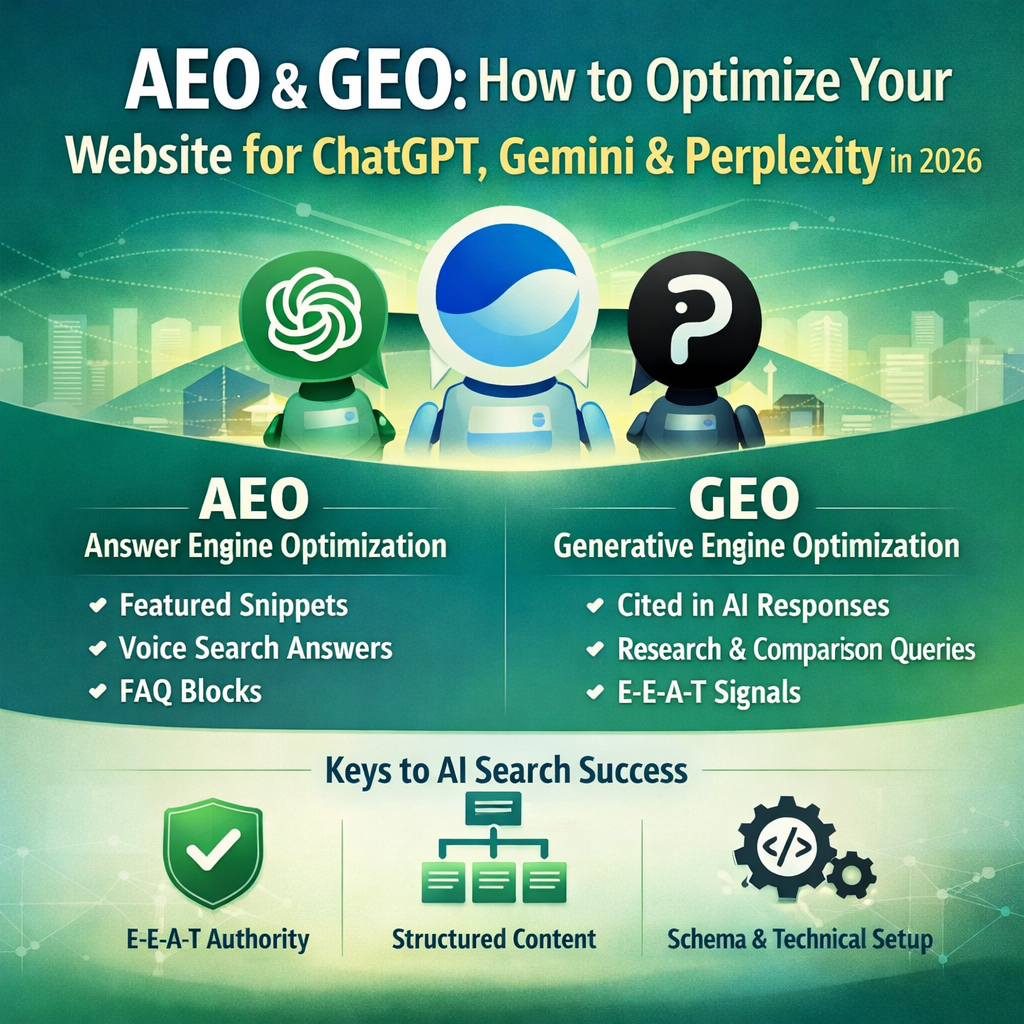
Search is no longer just about ranking on Google's ten blue links. In 2026, a significant and growing share of search queries are being answered directly by AI systems — ChatGPT, Gemini, Perplexity, Claude, and Microsoft Copilot. If your content isn't being cited in those answers, you're invisible to a rapidly expanding audience.
After 15 years in technical SEO and spending the last two years deep in AI search optimization, here is my practical breakdown of AEO (Answer Engine Optimization) and GEO (Generative Engine Optimization) — what they mean, how they differ, and exactly what you need to do to appear in AI-generated answers.
1. What is AEO vs GEO?
These two terms are often used interchangeably, but they describe subtly different goals:
AEO — Answer Engine Optimization
- Getting cited in direct answer boxes, featured snippets, and voice search responses
- Primarily focused on Google's AI Overviews (formerly SGE), Bing Copilot answers
- Targets structured, question-based queries with definitive answers
- Relies heavily on schema markup, FAQ blocks, and concise answer paragraphs
GEO — Generative Engine Optimization
- Appearing as a cited source in outputs from ChatGPT, Gemini, Perplexity, and similar generative AI tools
- Broader than AEO — covers brand mentions, entity recognition, and authoritative sourcing
- Targets research-intent and comparison queries where AI synthesizes multiple sources
- Relies on E-E-A-T signals, entity authority, and structured content depth
2. How AI Search Engines Decide What to Cite
Understanding how systems like Perplexity or Google's AI Overviews select sources is critical. These systems don't just crawl content — they evaluate signals that indicate authority and trustworthiness before deciding to surface or cite a page.
E-E-A-T Signals
Google's Quality Rater Guidelines concept of Experience, Expertise, Authoritativeness, and Trustworthiness has become the foundation for AI citation decisions. Generative AI systems trained on web data have internalized these same signals:
- Experience: Does the author demonstrate first-hand experience? (Case studies, real project examples, specific numbers)
- Expertise: Is the author credentialed or demonstrably skilled in this domain? (Author bio, credentials, linked profiles)
- Authoritativeness: Does the domain have external authority? (Backlinks from .edu/.gov domains, Wikipedia mentions, brand citations)
- Trustworthiness: Does the site have clear ownership, contact info, privacy policy, secure HTTPS, and no deceptive practices?
Structured Content Signals
AI extraction engines strongly prefer content with clear, predictable structure. Walls of text without headings, definitions, or direct answer blocks are much harder for AI to extract useful snippets from. Key structural signals include:
- Clear H2/H3 hierarchy that mirrors question intent
- Direct answer paragraphs (the first sentence directly answers the heading question)
- Definition blocks for key terms
- Numbered step-by-step procedures
- Comparison tables with clear labels
Schema and Entity Authority
Schema markup doesn't just help Google — it helps all AI crawlers understand the entities on your page. Organization schema with sameAs links to Wikidata, LinkedIn, and Crunchbase builds entity graph presence. Author markup with credentials signals expertise. FAQ schema makes Q&A pairs directly machine-readable.
3. Content Structure for AI Extraction
The way you structure your content is arguably more important for AEO/GEO than the raw quality of your writing. AI systems extract snippets, not full articles. Here's how to structure content for maximum extractability:
Direct Answer Blocks
Every section heading should be a question or a clear topic statement, followed immediately by a 2–3 sentence direct answer. This "inverted pyramid" structure puts the most extractable content first, before elaboration:
Direct Answer Pattern
Heading: "What is Answer Engine Optimization (AEO)?"
Direct answer paragraph (first): "Answer Engine Optimization (AEO) is the practice of structuring and marking up web content so that it is selected and displayed as the answer to a user query in AI-powered search interfaces, including Google AI Overviews, Bing Copilot, and voice assistants."
Then elaboration: Background, nuance, examples, related context.
FAQ Schema Blocks
FAQ schema (FAQPage with Question / Answer pairs) is one of the most powerful AEO signals available. It explicitly tells AI crawlers "here is a question and here is its answer" in machine-readable JSON-LD. Use it for:
- Common customer questions about your services
- "What is X?" definitional questions in your topic area
- "How do I..." procedural questions
- Pricing, process, and comparison questions
HowTo Schema
For step-by-step procedural content, HowTo schema with individual HowToStep items gives AI systems a structured, numbered procedure to extract and present. This works particularly well for Perplexity and Google AI Overviews on "how to" queries.
Concise Definitions
Add a dedicated "What is [term]?" paragraph near the top of pages targeting definitional queries. Keep definitions to 1–2 sentences. Use the exact phrase you're targeting as the heading. This mirrors how Wikipedia structures definitions — and AI systems have a strong affinity for Wikipedia-style authority.
4. Technical Signals for AI Citation Readiness
Beyond content structure, there are specific technical implementation signals that improve your AI citation readiness:
llms.txt
A new emerging standard (similar to robots.txt) — llms.txt placed at your domain root tells LLM crawlers which pages you want indexed and cited, and provides a structured summary of your site's content and purpose. Early adoption signals technical sophistication to AI systems.
# llms.txt — guidance for LLM crawlers
# https://anjubatta.github.io/llms.txt

> Anju Batta — Senior Full Stack Developer, Technical SEO Engineer
> and AI Automation Architect based in Chandigarh, India.

## Key Pages
- [About](https://anjubatta.github.io/): Author bio, credentials, services
- [Blog](https://anjubatta.github.io/blog): Technical articles on SEO, AI agents, Next.js

## Services
- Technical SEO Audits
- AI Agent Development (OpenAI, Claude, LangChain)
- Next.js / React Full Stack Development
Organization Schema with sameAs
The Organization or Person schema with a comprehensive sameAs array is critical for entity graph presence. Link to every authoritative profile that mentions your brand:
{
  "@context": "https://schema.org",
  "@type": "Person",
  "name": "Anju Batta",
  "jobTitle": "Senior Full Stack Developer & Technical SEO Engineer",
  "url": "https://anjubatta.github.io/",
  "sameAs": [
    "https://www.linkedin.com/in/anjubatta/",
    "https://github.com/anjubatta",
    "https://twitter.com/anjubatta"
  ],
  "knowsAbout": [
    "Technical SEO", "AI Agent Development",
    "Next.js", "AEO", "GEO"
  ]
}
Author Markup with Credentials
Every article should have explicit author markup in JSON-LD linking to an author profile page that itself has Person schema with credentials, social profiles, and areas of expertise. This creates a verifiable identity chain that AI systems can follow.
5. Practical GEO Tactics
GEO is ultimately about building the kind of authority that AI systems recognize as worth citing. These are the tactics with the highest ROI from my experience:
Brand Mentions and Citations
Unlinked brand mentions on authoritative domains still matter — AI systems are trained on web text and will associate your brand with a topic even without a hyperlink. Pursue guest posts, podcast appearances, industry directory listings, and press mentions in your niche. The goal is to have your name appear in the same context as the topics you want to be cited for.
Wikipedia and Wikidata Entity Presence
Wikipedia is disproportionately influential in AI training data. If you or your organization has a Wikipedia page, or is mentioned on relevant Wikipedia pages, that is an extremely strong entity authority signal. Wikidata entries with your official URL, social profiles, and area of expertise feed directly into Google's Knowledge Graph.
Authoritative Backlinks
Links from .edu domains, .gov domains, established news publications, and major industry sites are weighted heavily in both traditional SEO and AI citation signals. One link from a university research page mentioning your methodology is worth more than 100 directory links.
Content Freshness
AI systems like Perplexity that do live web retrieval strongly prefer recently updated content. Include a clear dateModified in your Article schema and keep content updated with the current year and fresh examples. Add a "Last updated" notice visible on the page.
Depth and Specificity
Generic content rarely gets cited by AI systems — there's simply too much of it. Content that makes specific, verifiable claims, provides concrete numbers, and names specific tools and methodologies is far more likely to be surfaced. Write like a subject matter expert giving a conference talk, not like someone writing for keyword density.
Summary: Your AEO / GEO Action Plan
- Audit your content structure — add direct answer paragraphs under every H2/H3
- Implement
FAQPageJSON-LD schema on all Q&A style content - Add or update
Person/Organizationschema with fullsameAslinks - Add author markup with credentials to every article
- Create or update your
llms.txtfile - Pursue brand mentions and citations from authoritative domain sources
- Keep content updated with
dateModifiedin schema and visible on-page - Ensure all critical content is server-rendered HTML, not JavaScript-dependent

Anju Batta
Senior Full Stack Developer, Technical SEO Engineer & AI Automation Architect with 15+ years of experience. Helping businesses get discovered in both traditional and AI-powered search from Chandigarh, India.
Get AEO / GEO Optimization Help →