📊 Need Help with Your Sitemap?
Our Technical SEO Consulting Service includes sitemap optimization, crawl budget analysis, and indexation improvements. Get a free audit →
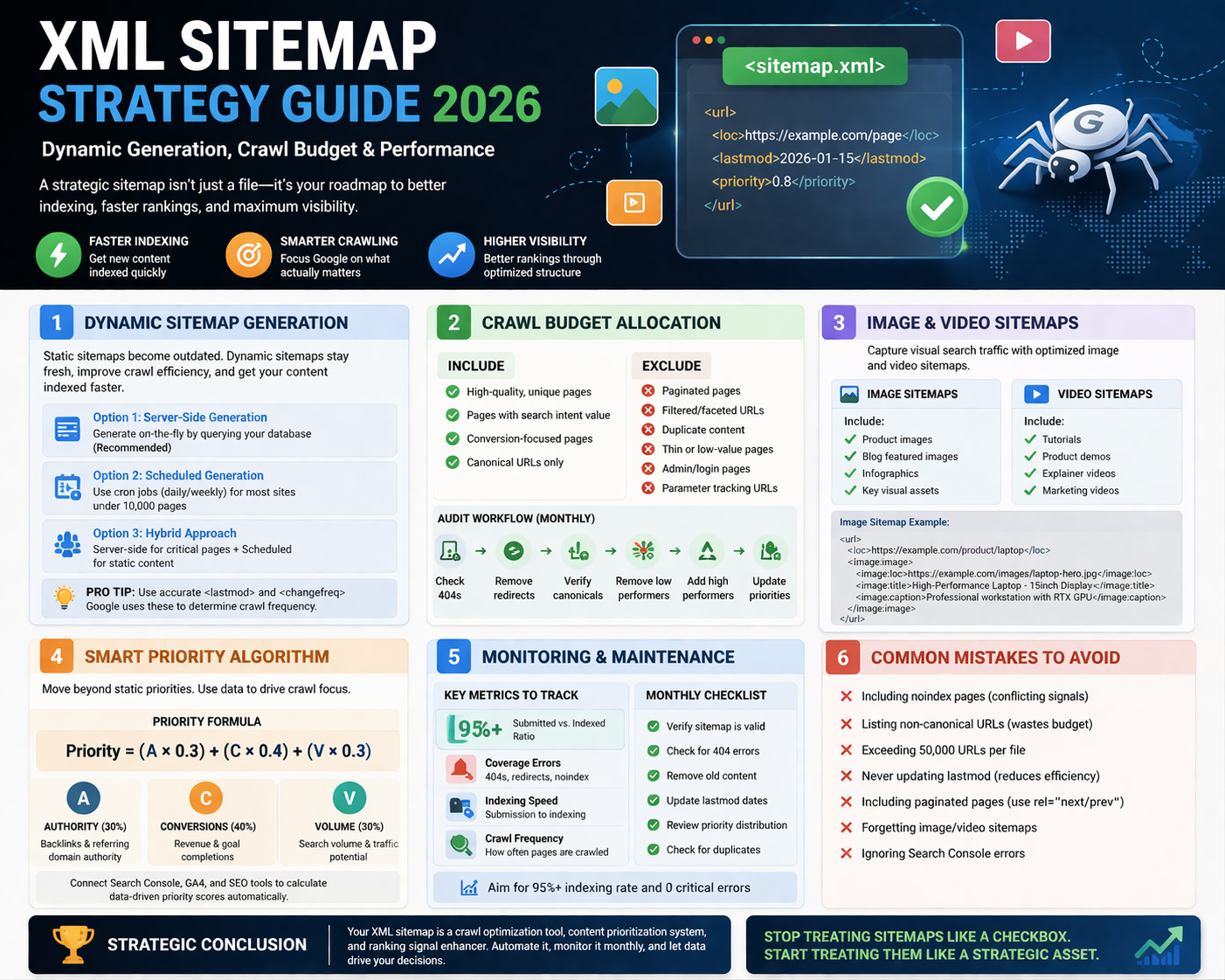
Your XML sitemap is no longer just a technical checkbox — it's a strategic SEO asset that directly influences crawl efficiency, indexing speed, and search rankings.
Most sites treat their sitemap as a "set it and forget it" file. That's a missed opportunity. In 2026, search engines are crawl-budget constrained, and a poorly maintained sitemap wastes precious crawl budget on low-value pages.
This guide covers advanced sitemap strategies, dynamic generation approaches, and maintenance workflows that separate effective SEO from mediocre SEO.
1. Dynamic Sitemap Generation
Static sitemaps quickly become outdated. The moment you publish or delete content, your sitemap is stale.
Why Dynamic Sitemaps Matter
- Automatic page inclusion — New content gets indexed faster
- Automatic removal — Deleted pages are removed before crawlers waste budget
- Freshness signals — Updated
<lastmod>timestamps improve crawl efficiency - Priority optimization — Adjust crawl priority based on real performance data
Implementation Approaches
Option 1: Server-side generation (recommended)
Generate the sitemap on-the-fly by querying your database. Services like Next.js App Router support dynamic route generation.
Option 2: Scheduled generation
Generate sitemaps via cron job (daily or weekly) and store as static files. Works well for most sites under 10,000 pages.
Option 3: Hybrid approach
Use server-side generation for critical pages (blog posts, products) and scheduled generation for static content (about, contact).
<changefreq> and accurate <lastmod> timestamps. Google uses these signals to determine crawl frequency — pages marked "daily" with recent timestamps get crawled more often.
2. Crawl Budget Allocation
You have a finite crawl budget. Google decides how often to crawl your site based on site size, update frequency, and infrastructure signals.
What to Include
- High-quality, unique pages
- Pages with search intent value
- Conversion-focused pages
- Canonical URLs only (never alternate URLs)
What to Exclude
- Paginated pages (use rel="next/prev" instead)
- Filtered or faceted URLs
- Duplicate content variations
- Thin or low-value pages
- Admin/login/user-account pages
- Parameter-based tracking URLs
The Sitemap Audit Workflow
Conduct a monthly sitemap audit:
- Check for 404 errors in Search Console (critical issue)
- Remove 301/302 redirected URLs
- Verify all URLs match canonical versions
- Remove low-performing pages from sitemap
- Add newly high-performing pages
- Update priority scores based on current performance
3. Image & Video Sitemaps
Visual search is increasingly important in 2026. A significant portion of traffic now comes from image search and video search engines.
Image Sitemap Strategy
Include:
- High-quality product images
- Blog featured images
- Infographics and charts
- Key visual assets
Don't include: Low-quality thumbnails, decorative images, or duplicate sizes of the same image.
Image sitemap example:
<url>
  <loc>https://example.com/product/laptop</loc>
  <image:image>
    <image:loc>https://example.com/images/laptop-hero.jpg</image:loc>
    <image:title>High-Performance Laptop - 15inch Display</image:title>
    <image:caption>Professional workstation with RTX GPU</image:caption>
  </image:image>
</url>
Video Sitemap Strategy
Include:
- Tutorials and how-to videos
- Product demos
- Explainer videos
- Marketing/brand videos
Benefits: Rich video results in search, increased CTR, and video search traffic.
4. Smart Priority Algorithm
Static priority values (0.1 to 1.0) are outdated. Move to data-driven priority scoring.
Dynamic Priority Formula
Priority = (Authority × 0.3) + (Conversions × 0.4) + (Volume × 0.3)Components Explained
- Authority (30%) — Backlink count, referring domain authority
- Conversions (40%) — Actual revenue or goal completions from the page
- Search Volume (30%) — Potential traffic based on keyword volume
Implementation
Connect your sitemap generation to analytics and SEO data:
- Query Google Search Console API for impressions/clicks
- Pull conversion data from GA4 or your e-commerce system
- Use Ahrefs/SEMrush API for backlink data
- Calculate priority scores dynamically
5. Monitoring & Maintenance
Key Search Console Metrics
- Submitted vs. Indexed ratio — Aim for 95%+ indexing
- Coverage errors — 404s, redirects, noindex conflicts
- Indexing speed — Time from submission to indexing
- Crawl frequency — How often pages are crawled
Monthly Maintenance Checklist
- Verify sitemap is valid (no XML errors)
- Check for 404s in Search Console Coverage report
- Remove/redirect old content
- Update lastmod timestamps for changed content
- Review priority distribution (not all 0.8 or 0.9)
- Check for duplicate URLs across multiple sitemaps
6. Common Sitemap Mistakes to Avoid
- Including noindex pages — Sends conflicting signals to Google
- Listing non-canonical URLs — Wastes crawl budget on duplicates
- Exceeding 50,000 URLs per file — Create multiple sitemaps with sitemap index
- Never updating lastmod — Reduces crawl efficiency
- Including paginated pages — Use rel="next/prev" instead
- Forgetting image/video sitemaps — Missing visual search traffic
- Ignoring Search Console errors — Letting broken pages sit in sitemap
Strategic Conclusion
Your XML sitemap should be treated as:
- A crawl optimization tool that guides Google to high-value pages
- A content prioritization system based on business value
- A ranking signal enhancer through freshness and structure
The Shift You Need to Make
Stop treating your sitemap like a checkbox task. Start treating it like a strategic SEO asset that directly impacts rankings, indexing speed, and visibility.
Automate your sitemap generation, monitor it monthly, and let the data drive your priority decisions.

Anju Batta
Senior Full Stack Developer, Technical SEO Engineer & AI Automation Architect with 15+ years of experience. I help sites optimize their technical SEO infrastructure, including sitemap strategy and crawl budget management.
Optimize Your Sitemap →